|
Research Topics
My primary research interests lie in audio understanding and generation.
Previously, I have worked on text-to-audio generation, large audio language models, contrastive language-audio pre-training and spoken dialogue systems.
|
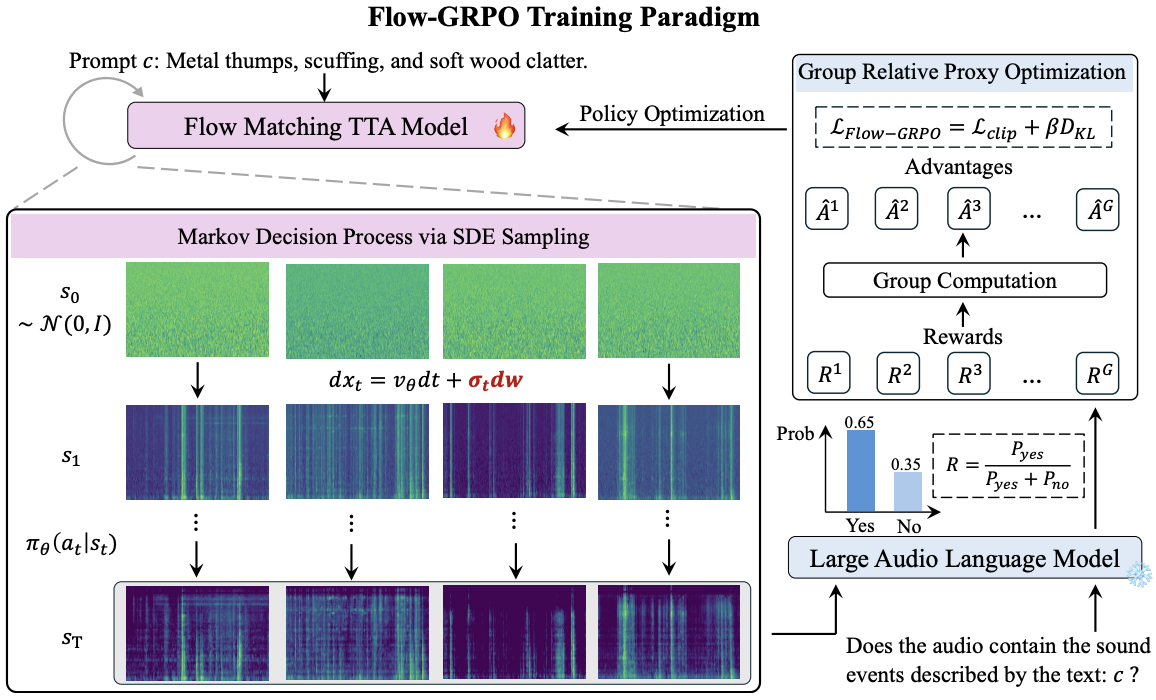
Resonate: Reinforcing Text-to-Audio Generation via Online Feedback from Large Audio Language Models
Xiquan Li, Junxi Liu, Wenxi Chen, Haina Zhu, Ziyang Ma, Xie Chen
arXiv, 2026
Paper
/
Code
/
Demo
Reinforcement Learning (RL) has become an effective paradigm for enhancing Large Language Models (LLMs) and visual generative models. However, its application in text-to-audio (TTA) generation remains largely under-explored. Prior work typically employs offline methods like Direct Preference Optimization (DPO) and leverages Contrastive Language-Audio Pretraining (CLAP) models as reward functions. In this study, we investigate the integration of online Group Relative Policy Optimization (GRPO) into TTA generation. We adapt the algorithm for Flow Matching-based audio models and demonstrate that online RL significantly outperforms its offline counterparts. Furthermore, we incorporate rewards derived from Large Audio Language Models (LALMs), which can provide fine-grained scoring signals that are better aligned with human perception. With only 470M parameters, our final model, \textbf{Resonate}, establishes a new SOTA on TTA-Bench in terms of both audio quality and semantic alignment.
|
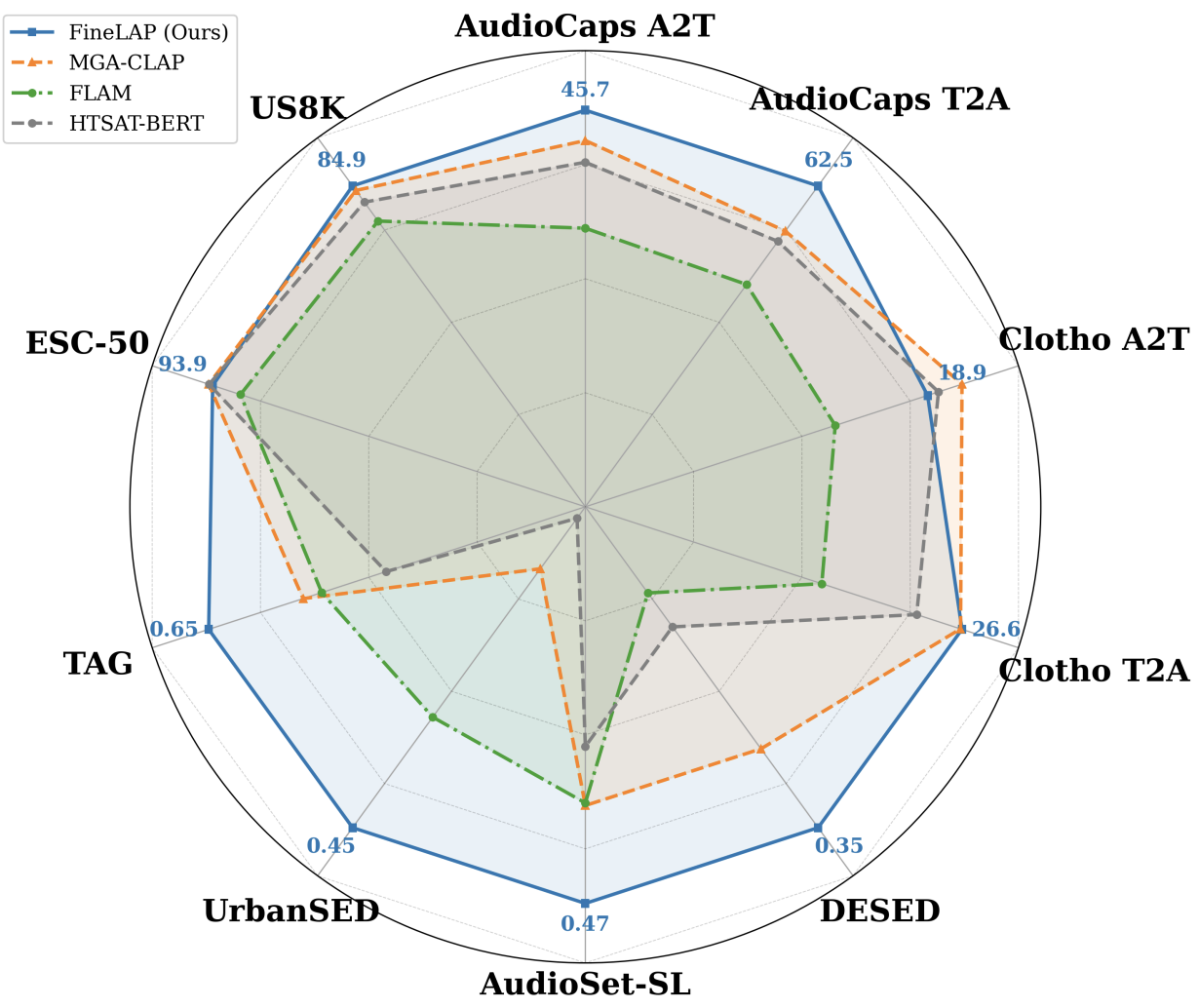
FineLAP: Taming Heterogeneous Supervision for Fine-grained Language-Audio Pretraining
Xiquan Li, Xuenan Xu, Ziyang Ma, Wenxi Chen, Haolin He, Qiuqiang Kong, Xie Chen
arXiv, 2026
Paper
/
Code
/
Dataset
Contrastively pretrained audio-language models (e.g., CLAP) excel at clip-level understanding but struggle with frame-level tasks. Existing extensions fail to exploit the varying granularity of real-world audio-text data, where massive clip-level textual descriptions coexist with limited frame-level annotations. This paper proposes Fine-grained Language-Audio Pretraining (FineLAP), a novel training paradigm that advances both clip- and frame-level alignment in CLAP with heterogeneous data. FineLAP introduces a dual-stream sigmoid loss with a cluster-based sampling strategy to jointly learn from clip- and frame-level supervision. To capture both global semantics and local details, FineLAP uses a decoupled audio projector on top of a self-supervised encoder. To alleviate the scarcity of temporally annotated data, we present FineLAP-100k, a large-scale synthetic SED dataset constructed through a scalable curation pipeline. Extensive experiments demonstrate that FineLAP achieves SOTA performance across multiple audio understanding tasks, including retrieval, classification, sound event detection, and text-to-audio grounding. Ablation studies further show that coarse- and fine-grained alignment are mutually beneficial, providing insights for building better audio-language models (ALMs).
|
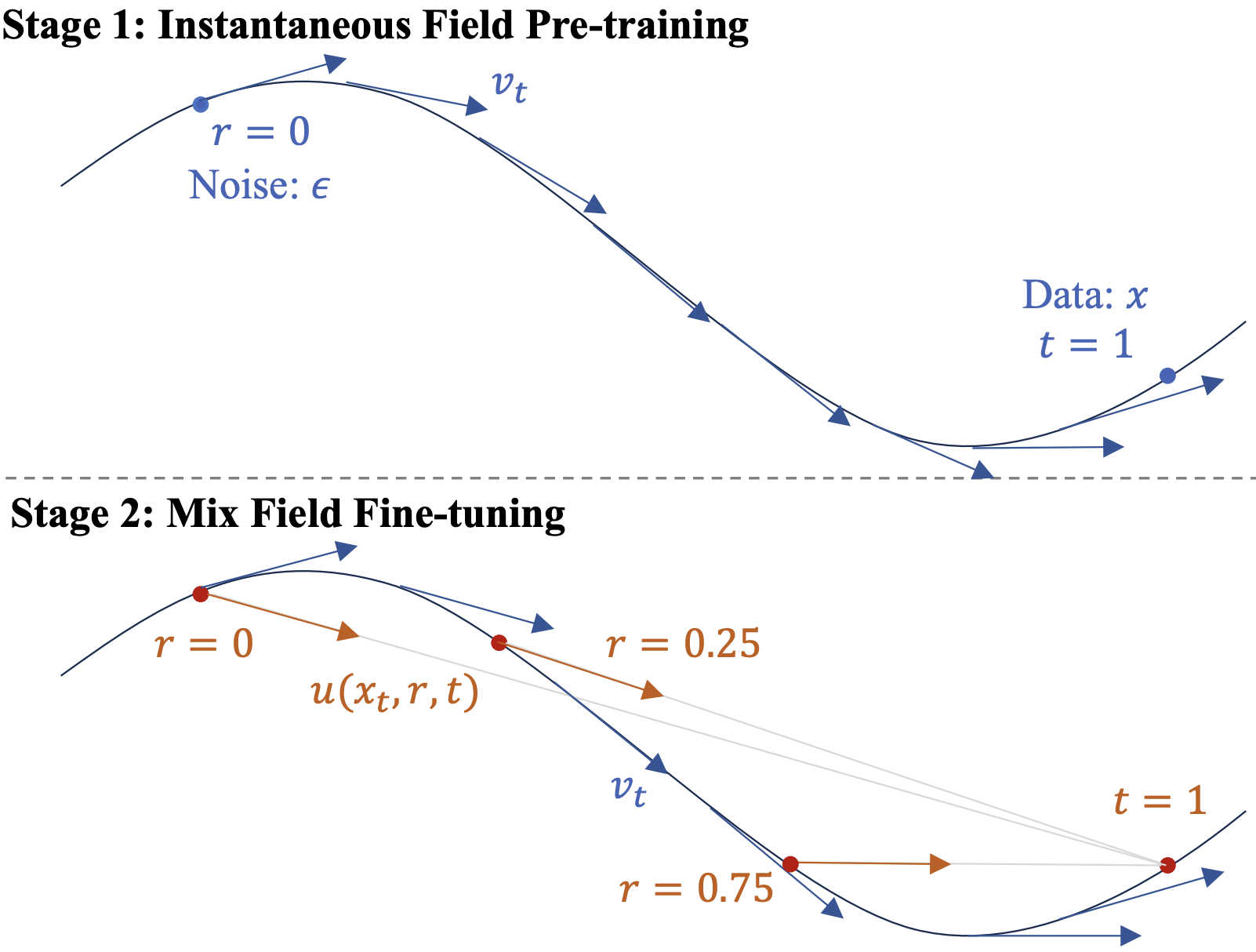
MeanAudio: Fast and Faithful Text-to-Audio Generation with Mean Flows
Xiquan Li*, Junxi Liu*, Yuzhe Liang, Zhikang Niu, Wenxi Chen, Xie Chen
arXiv, 2025
Paper
/
Code
/
Demo
Recent years have witnessed remarkable progress in Text-to-Audio Generation (TTA), providing sound creators with powerful tools to transform inspirations into vivid audio. Yet despite these advances, current TTA systems often suffer from slow inference speed, which greatly hinders the efficiency and smoothness of audio creation. In this paper, we present MeanAudio, a fast and faithful text-to-audio generator capable of rendering realistic sound with only one function evaluation (1-NFE). MeanAudio leverages: (i) the MeanFlow objective with guided velocity target that significantly accelerates inference speed, (ii) an enhanced Flux-style transformer with dual text encoders for better semantic alignment and synthesis quality, and (iii) an efficient instantaneous-to-mean curriculum that speeds up convergence and enables training on consumer-grade GPUs. Through a comprehensive evaluation study, we demonstrate that MeanAudio achieves state-of-the-art performance in single-step audio generation. Specifically, it achieves a real-time factor (RTF) of 0.013 on a single NVIDIA RTX 3090, yielding a 100x speedup over SOTA diffusion-based TTA systems. Moreover, MeanAudio also shows strong performance in multi-step generation, enabling smooth transitions across successive synthesis steps.
|
Towards Reliable Large Audio Language Model
Ziyang Ma, Xiquan Li, Yakun Song, Wenxi Chen, Chenpeng Du, Jian Wu, Yuanzhe Chen, Zhuo Chen, Yuping Wang, Yuxuan Wang, Xie Chen
ACL, 2025 (Findings)
Paper
Recent advancements in large audio language models (LALMs) have demonstrated impressive results and promising prospects in universal understanding and reasoning across speech, music, and general sound. However, these models still lack the ability to recognize their knowledge boundaries and refuse to answer questions they don't know proactively. While there have been successful attempts to enhance the reliability of LLMs, reliable LALMs remain largely unexplored. In this paper, we systematically investigate various approaches towards reliable LALMs, including training-free methods such as multi-modal chain-of-thought (MCoT), and training-based methods such as supervised fine-tuning (SFT). Besides, we identify the limitations of previous evaluation metrics and propose a new metric, the Reliability Gain Index (RGI), to assess the effectiveness of different reliable methods. Our findings suggest that both training-free and training-based methods enhance the reliability of LALMs to different extents. Moreover, we find that awareness of reliability is a "meta ability", which can be transferred across different audio modalities, although significant structural and content differences exist among sound, music, and speech.
|
URO-Bench: A Comprehensive Benchmark for End-to-End Spoken Dialogue Models
Ruiqi Yan, Xiquan Li, Wenxi Chen, Zhikang Niu, Chen Yang, Ziyang Ma, Kai Yu, Xie Chen
EMNLP, 2025 (Findings)
Paper
/
Code
/
Dataset
In recent years, with advances in large language models (LLMs), end-to-end spoken dialogue models (SDMs) have made significant strides. Compared to text-based LLMs, the evaluation of SDMs needs to take speech-related aspects into account, such as paralinguistic information and speech quality. However, there is still a lack of comprehensive evaluations for SDMs in speech-to-speech (S2S) scenarios. To address this gap, we propose URO-Bench, an extensive benchmark for SDMs. Notably, URO-Bench is the first S2S benchmark that covers evaluations about multilingualism, multi-round dialogues, and paralinguistics. Our benchmark is divided into two difficulty levels: basic track and pro track, consisting of 16 and 20 datasets respectively, evaluating the model's abilities in Understanding, Reasoning, and Oral conversation. Evaluations on our proposed benchmark reveal that current open-source SDMs perform rather well in daily QA tasks, but lag behind their backbone LLMs in terms of instruction-following ability and also suffer from catastrophic forgetting. Their performance in advanced evaluations of paralinguistic information and audio understanding remains subpar, highlighting the need for further research in this direction. We hope that URO-Bench can effectively facilitate the development of spoken dialogue models by providing a multifaceted evaluation of existing models and helping to track progress in this area.
|
DRCap: Decoding CLAP Latents with Retrieval-Augmented Generation for Zero-shot Audio Captioning
Xiquan Li, Wenxi Chen, Ziyang Ma, Xuenan Xu, Yuzhe Liang, Zhisheng Zheng, Qiuqiang Kong, Xie Chen
ICASSP, 2025 (Oral)
Paper
/
Code
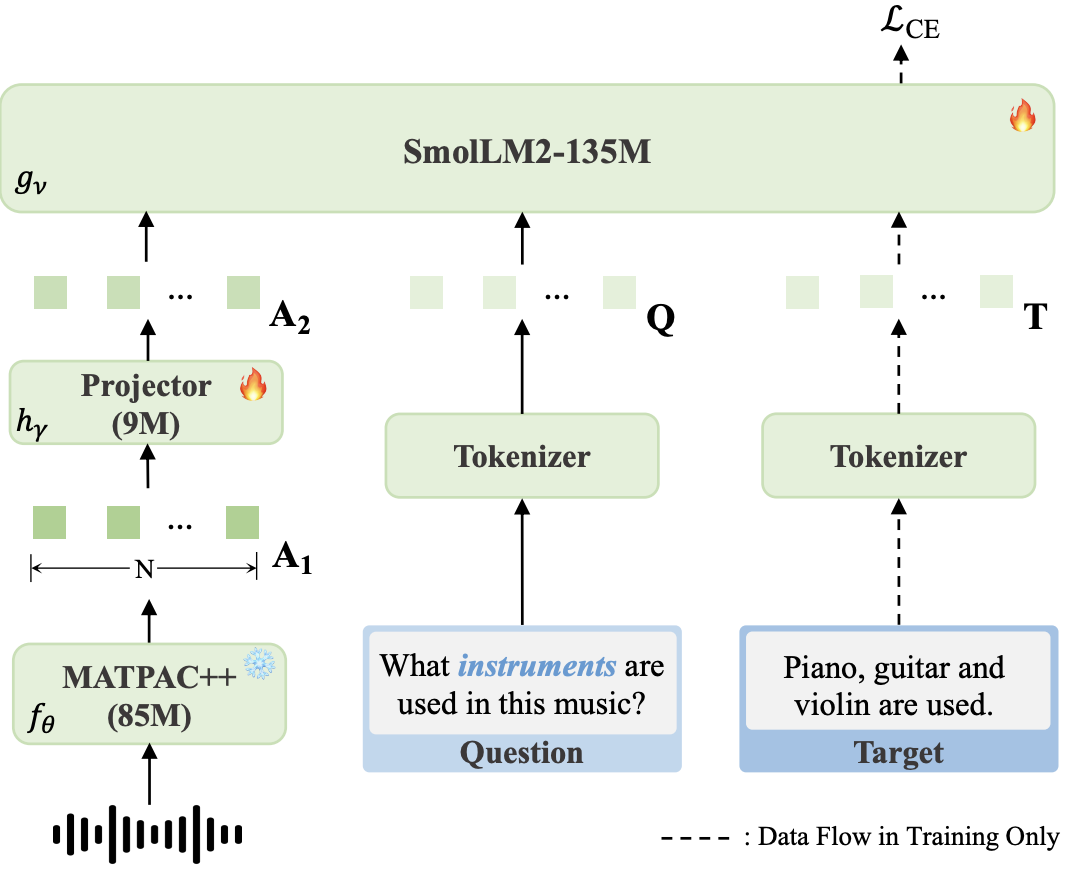
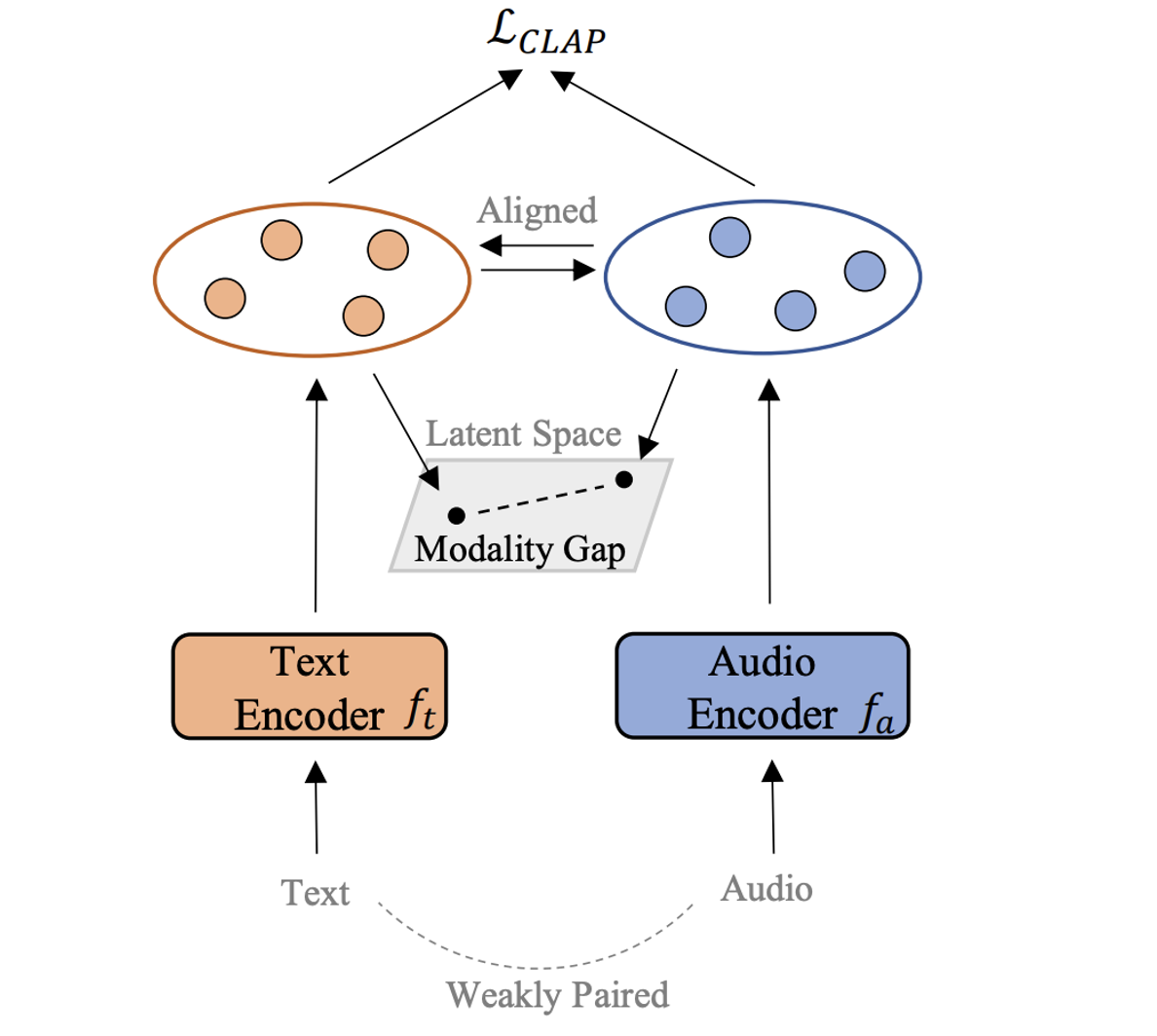
While automated audio captioning (AAC) has made notable progress, traditional fully supervised AAC models still face two critical challenges: the need for expensive audio-text pair data for training and performance degradation when transferring across domains. To overcome these limitations, we present DRCap, a data-efficient and flexible zero- shot audio captioning system that requires text-only data for training and can quickly adapt to new domains without additional fine-tuning. DRCap integrates a contrastive language-audio pre-training (CLAP) model and a large language model (LLM) as its backbone. During training, the model predicts the ground-truth caption with a fixed text encoder from CLAP, whereas, during inference, the text encoder is replaced with the audio encoder to generate captions for audio clips in a zero-shot manner. To mitigate the modality gap of the CLAP model, we use both the projection strategy from the encoder side and the retrieval-augmented generation strategy from the decoder side. Specifically, audio embeddings are first projected onto a text embedding support to absorb extensive semantic information within the joint multi-modal space of CLAP. At the same time, similar captions retrieved from a datastore are fed as prompts to instruct the LLM, incorporating external knowledge to take full advantage of its strong generative capability. Conditioned on both the projected CLAP embedding and the retrieved similar captions, the model is able to produce a more accurate and semantically rich textual description. By tailoring the text embedding support and the caption datastore to the target domain, DRCap acquires a robust ability to adapt to new domains in a training-free manner. Experimental results demonstrate that DRCap outperforms all other zero-shot models in in- domain scenarios and achieves state-of-the-art performance in cross- domain scenarios.
|
SLAM-AAC: Enhancing Audio Captioning with Paraphrasing Augmentation and CLAP-Refine through LLMs
Wenxi Chen*, Ziyang Ma*, Xiquan Li, Xuenan Xu, Yuzhe Liang, Zhisheng Zheng, Kai Yu, Xie Chen
ICASSP, 2025
Paper
/
Code
Automated Audio Captioning (AAC) aims to generate natu- ral textual descriptions for input audio signals. Recent progress in audio pre-trained models and large language models (LLMs) has significantly enhanced audio understanding and textual reasoning capabilities, making improvements in AAC possible. In this paper, we propose SLAM-AAC to further enhance AAC with paraphrasing augmentation and CLAP- Refine through LLMs. Our approach uses the self-supervised EAT model to extract fine-grained audio representations, which are then aligned with textual embeddings via lightweight linear layers. The caption generation LLM is efficiently fine-tuned using the LoRA adapter. Drawing inspiration from the back-translation method in machine translation, we implement paraphrasing augmentation to expand the Clotho dataset during pre-training. This strategy helps alleviate the limitation of scarce audio-text pairs and generates more diverse captions from a small set of audio clips. During inference, we introduce the plug-and-play CLAP-Refine strategy to fully exploit multiple decoding outputs, akin to the n-best rescoring strategy in speech recognition. Using the CLAP model for audio-text similarity calculation, we could select the textual descriptions generated by multiple searching beams that best match the input audio. Experimental results show that SLAM-AAC achieves state- of-the-art performance on Clotho V2 and AudioCaps, surpassing previous mainstream models.
|
Shanghai Jiao Tong University, Shanghai, China
M.E. in Information Engineering • Sep. 2024 – March. 2027
|
 |
Télécom Paris, Palaiseau, France
M.E. in Information Engineering • Sep. 2023 – Jun. 2026
|
 |
Shanghai Jiao Tong University, Shanghai, China
B.E. in Information Engineering, Dual degree in French • Sep. 2020 – Jun. 2024
|
 |
Hunyuan Team, Tencent, Shanghai, China
Intern • June 2025 – November 2025
|
 |
ADASP Group, Télécom Paris, Palaiseau, France
Research Intern • Sep. 2024 – June. 2025
Advisor: Slim Essid
|
 |
DSP Lab, The Chinese University of Hong Kong, Hongkong, China
Research Assisstant • June. 2024 – Sep. 2024
Advisor: Qiuqiang Kong
|
 |
X-LANCE Lab, Shanghai Jiao Tong University, Shanghai, China
Research Intern • Jan. 2023 – Now
Advisor: Xie Chen
|
 |
|
Misc.
Apart from research, I love skiing, playing soccer and hitting the gym. Check out some of the wonderful ski moments here :)
|
|